Top Signs You Need Garage Door Service – Don’t Ignore These
A garage door that takes three seconds longer to open than it did six months ago isn’t “getting old.” It’s telling you the springs are losing tension, and that specific symptom typically precedes a full spring failure by four to eight weeks. The same is true of a new grind, a slight lean, or an opener that hesitates before it moves. Garage doors rarely fail without warning. They telegraph what’s coming through changes in speed, sound, force, and alignment. This guide gives you the vocabulary to read those signs in Tremont, so you can schedule service on your terms instead of waiting for a snapped cable at the worst possible moment. If you’d rather not diagnose it yourself, call (855) 337-1175.
Why Garage Door Problems Give You Notice First
A garage door is a balanced system, not a simple motorized slab. Torsion or extension springs carry most of the door’s weight, cables transfer that load, rollers and hinges guide the panels, and the opener supplies only a fraction of the force needed to lift the whole thing. When any one part drifts out of spec, the rest of the system compensates, and that compensation shows up as a change you can see or hear.
That’s why the earliest signs are rarely dramatic. They’re subtle: a door that surges at the start of its cycle, a thump near the top of travel, a roller that squeals only in cold weather. In our experience, homeowners in Tremont often notice these changes for weeks before something breaks and assume it’s normal wear. It isn’t normal; it’s a message. Learning to read it is the difference between a scheduled repair and an emergency call.
The four channels to watch are speed, balance, sound, and alignment. Each one fails in a predictable order, and each maps to a different component.
Sign #1: The Door Is Getting Slower or Struggling to Balance
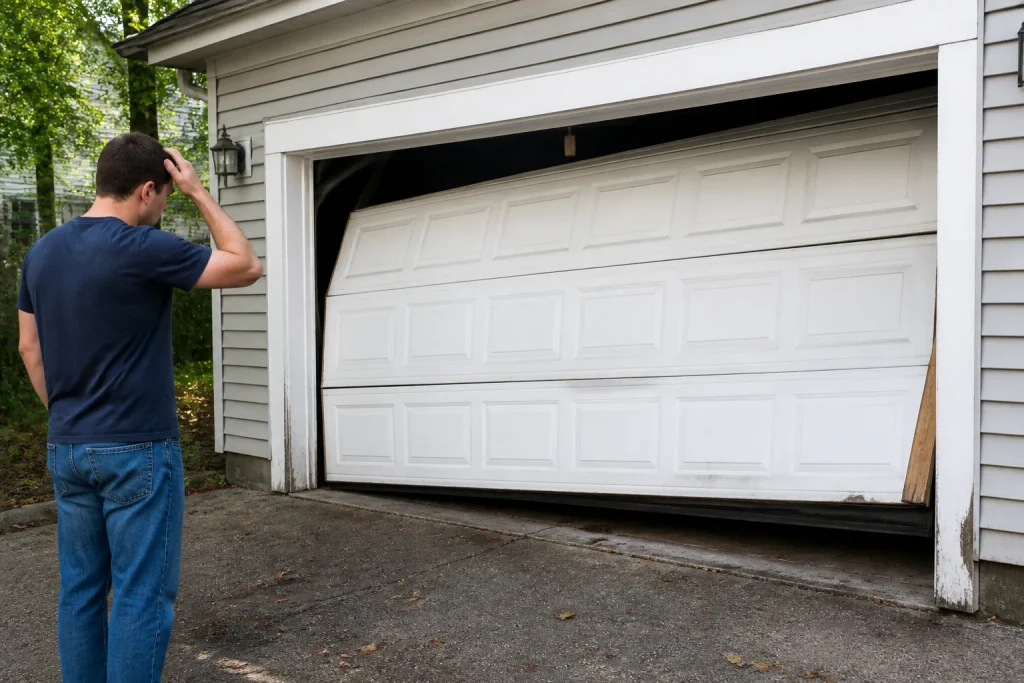
Speed and balance changes are the most reliable early-warning indicators you have. When springs lose tension, the opener has to work harder to lift the door, so the door moves more slowly, surges partway up, or stalls near the top. A door that used to open smoothly in one motion and now hesitates halfway is a door with a spring problem, not an opener problem.
You can check balance without touching any moving part. Disconnect the opener using the manual release cord (pull it with the door fully closed), then lift the door halfway by hand and let go. A properly balanced door stays put or drifts slowly and evenly. If it drops fast, sags to one side, or feels heavy as you raise it, the springs are out of adjustment or worn.
Do not try to adjust, wind, or replace springs yourself. Torsion springs hold enough stored energy to cause serious injury, and this is not a component to experiment with. That’s skilled, safety-critical work for trained technicians.
How to read what you’re feeling:
- Door feels heavy from the start: spring tension is low, likely on both springs if the door was replaced as a pair.
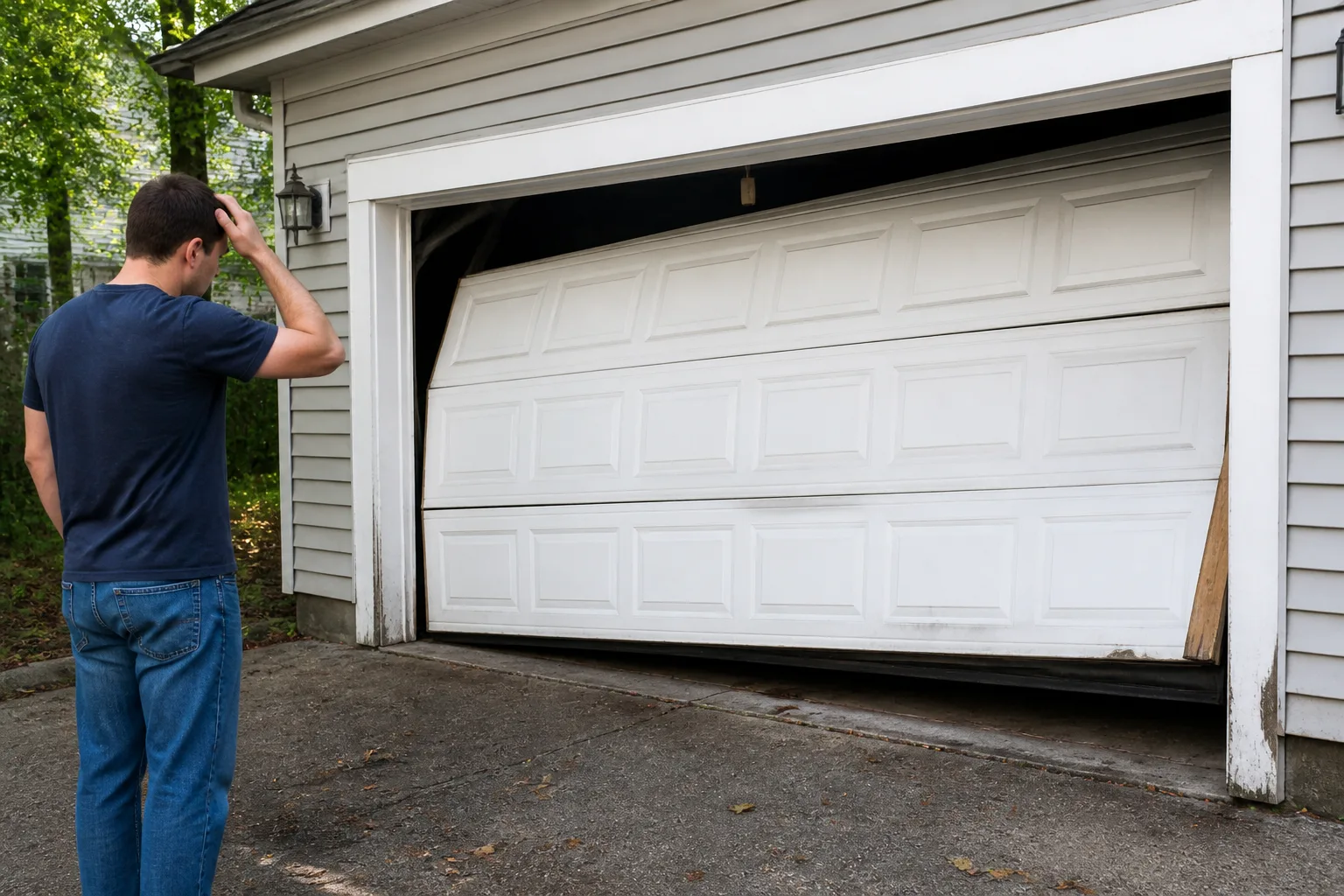
- Door sags to one side: one spring has failed or a cable has slackened.
- Door surges then slows: springs are partially worn, or the opener is straining to compensate.
- Door won’t stay at halfway: balance is off, and the opener is doing work it wasn’t designed to do.
If you notice any of these, treat it as your four-to-eight-week warning window. Our garage door repair team can check spring tension, cable condition, and balance in a single visit.
Sign #2: New Noises (And What Each One Means)
Sound is the most diagnostic signal a garage door gives you, because each noise comes from a specific part. If you can describe the sound accurately, you’ve already narrowed down the cause. Here’s the taxonomy we use in Tremont:
- Grinding: worn rollers, dry hinges, or a lack of lubrication on the moving parts. Usually the earliest and most fixable sign.
- Banging or popping: spring or cable tension problems. A loud bang from the torsion bar area often means a spring has snapped.
- Scraping: the door is rubbing against the track, usually because the track has shifted or a panel is out of alignment.
- Clicking or a rhythmic knock: a stripped gear in the opener, or a chain or belt that has slackened.
Grinding and scraping are typically “schedule service” noises. Banging, especially a single loud pop followed by a door that won’t lift, is a “stop using the door” noise. If you hear that pop, lower the door if you can do so safely, disconnect the opener, and call for service before using it again. A door with a broken spring is heavy and unpredictable.
One more note: a door that squeals only in winter is usually a lubrication issue on the rollers and hinges, not a mechanical failure. That one’s worth a quick check before you assume the worst.
Sign #3: Visible Cable Damage
Cables run alongside the springs and are the second most stressed part of the system. They’re also the easiest component to inspect visually. Stand to the side of the door (never directly underneath), look at each cable, and check for three specific patterns:
- Frayed cables: broken strands poking out along the length. This means the cable is failing and needs replacement before it snaps.
- Kinked cables: a sharp bend or kink in the wire, often caused by a cable that jumped its drum. A kinked cable is a weakened cable.
- Slack cables: a cable that hangs loose when the door is closed. Slack usually means a spring has lost tension or a drum has slipped, and it can lead to the cable coming off the drum entirely.
Each pattern tells a different story. Fraying is wear. Kinking is a mechanical event. Slack is a symptom of a spring problem upstream. In all three cases, cables carry high tension, so leave the replacement to a technician. Frayed or slack cables are a “don’t use the door” situation.
Sign #4: Opener Behavior Changes
Your opener is a smart device, and it behaves differently when something is wrong. Watch for these three patterns, because each points to a different internal component:
- Delayed response: the door waits a beat or two after you press the remote. This often points to a worn logic board, a failing capacitor, or a signal problem between the remote and the unit.
- Motor runs but the door doesn’t move: the opener is running but the door stays put, or stops partway. A stripped gear in the drive assembly is a common cause, especially on older chain-drive units.
- Partial reversal: the door starts down, then reverses before it closes. This can be a misaligned safety sensor, a force setting that’s out of calibration, or an obstruction the sensor is reading incorrectly.
Smart openers from LiftMaster and Chamberlain add one more diagnostic layer: check the app. If the unit reports a fault code or shows a repeated force-limit trip, that’s a specific internal signal you can hand to a technician. That’s a big part of why we work so closely with those two brands, along with Craftsman and Genie, because knowing the platform makes diagnosis faster.
Delayed response and partial reversal are usually “schedule service” signs. A motor that runs with no door movement is a “stop using the door” sign, because continuing to run the motor on a stuck door can damage the gear train further.
When It’s Time to Call a Pro Instead of Watching
Some signs can wait for a scheduled appointment. Others mean the door should stay closed until a technician sees it. Here’s the line we draw for Tremont homeowners:
- Schedule service: grinding or squealing, delayed opener response, partial reversal, slow opening, or a door that needs extra force to close.
- Stop using the door: a loud pop or bang, a door that won’t lift, a slack or frayed cable, a visibly sagging door, or an opener motor running with no movement.
Here’s the one place we’ll allow ourselves a small joke: if your door has developed a personality, it’s not being quirky. It’s failing, and the personality is called “spring fatigue.” A door that behaves differently every time you press the button needs a diagnosis, not patience.
We find the actual cause, not just the symptom. Our technicians have up to 12 years of experience and are familiar with Genie, Clopay, Amarr, and Wayne Dalton systems as well as the openers we mentioned above, so the first visit usually resolves the issue. Once the door is running correctly, a properly maintained system is one that opens the first time, every time.
Related services in Tremont: for a full-system tune-up or repair, see garage door repair in Tremont. If the issue traces to the opener itself, our garage door opener repair covers the diagnosis. And if the door is past repair, garage door installation walks you through a replacement.
The Bottom Line
The signs that a garage door is heading toward failure are specific and readable: slowing speed, a door that won’t hold halfway, new noises with distinct causes, visible cable damage, and opener behavior that changes. You don’t need to memorize the whole list; you just need to notice when something shifts from normal. The four-to-eight-week window between a symptom and a failure is real, and using it means a scheduled repair instead of an emergency call.
If you’re in Tremont and need help, Garage Door Repair Tremont offers free estimates – call (855) 337-1175. We handle repair, spring repair, opener repair, installation, and emergency service, and we work on the brands your door and opener already are. One call resolves any garage door problem.
Frequently Asked Questions
A door that’s getting slower, feels heavy when you lift it by hand, or won’t stay at halfway is showing spring wear, and that usually appears four to eight weeks before a full failure. A single loud pop followed by a door that won’t lift means the spring has already broken. Stop using the door and call for service.
No. Torsion and extension springs hold enough stored energy to cause serious injury, and the winding process requires specialized tools and training. This is safety-critical work that trained technicians handle. Call (855) 337-1175 and we’ll take a look.
Grinding usually points to worn rollers, dry hinges, or missing lubrication on the moving parts, and it’s often the earliest and most fixable sign. Scraping means the door is rubbing the track, while banging points to spring or cable tension. If you’re hearing a grind in Tremont, schedule a check before it turns into something worse.
No. Stop using the door and disconnect the opener if you can do so safely. A motor running against a stuck door typically means a stripped gear or a broken drive component, and continuing to run it can damage the system further. Call (855) 337-1175 for a diagnosis.
Written by the team at Garage Door Repair Tremont.
Need Garage Door Help?
Call Garage Door Repair Tremont - the local pro we connect you with is licensed and insured, here with fast after-hours help in Tremont.
(855) 337-1175