Emergency Garage Door Repair Near Me: What Tremont Homeowners Should Do First
The most expensive mistake we see after a garage door fails in Tremont is someone trying to force it open by hand. From the outside, the door looks and feels about the same as always. What you can’t feel is that a snapped torsion spring has removed the counterbalance, so you’re now lifting the full dead weight of the door, usually with a car waiting behind it. The 15 minutes after a failure decide whether you have a simple spring replacement or a bent track, cracked panel, and a much bigger bill. Here’s the sequence we’d follow.
If you’d rather not DIY it, call (855) 337-1175 and we’ll talk through what’s happening before anyone gets hurt or makes it worse.
First, Identify What Actually Failed (Before You Touch Anything)
Before you pull a cord or push a button twice, do a visual check from outside the door with the opener disconnected only mentally, not physically. Stand back and look at the door in the closed position. A torsion spring lives on the horizontal shaft above the door; an extension spring runs along the track on each side. If either is visibly split, stretched, or hanging loose, you have your answer and you should stop there at first pass. A snapped torsion spring often sits as two separate coils with a visible gap.
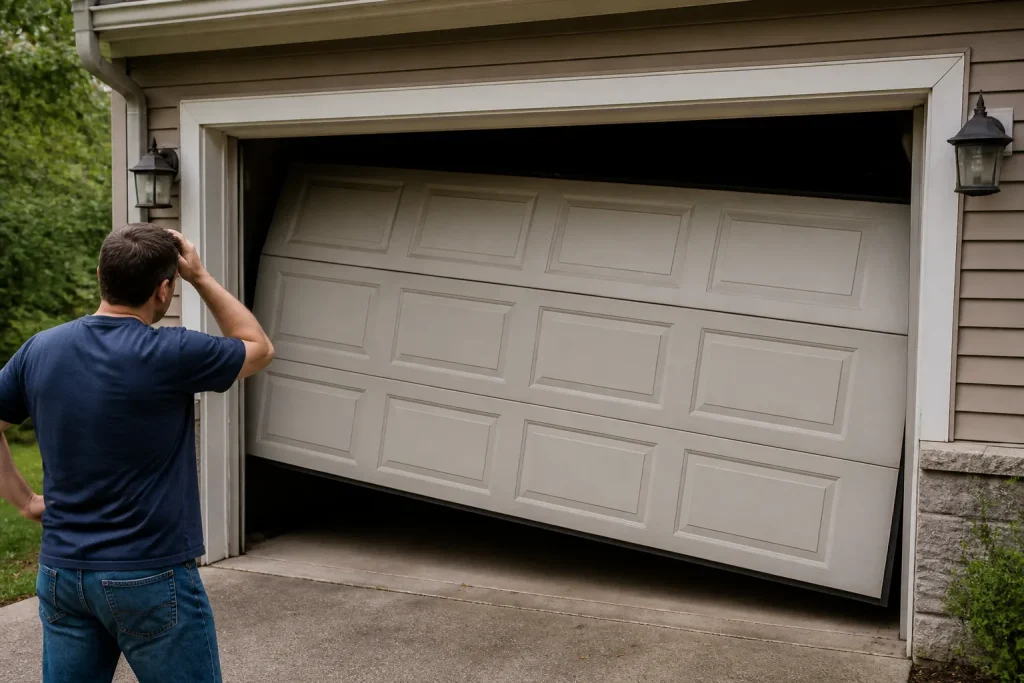
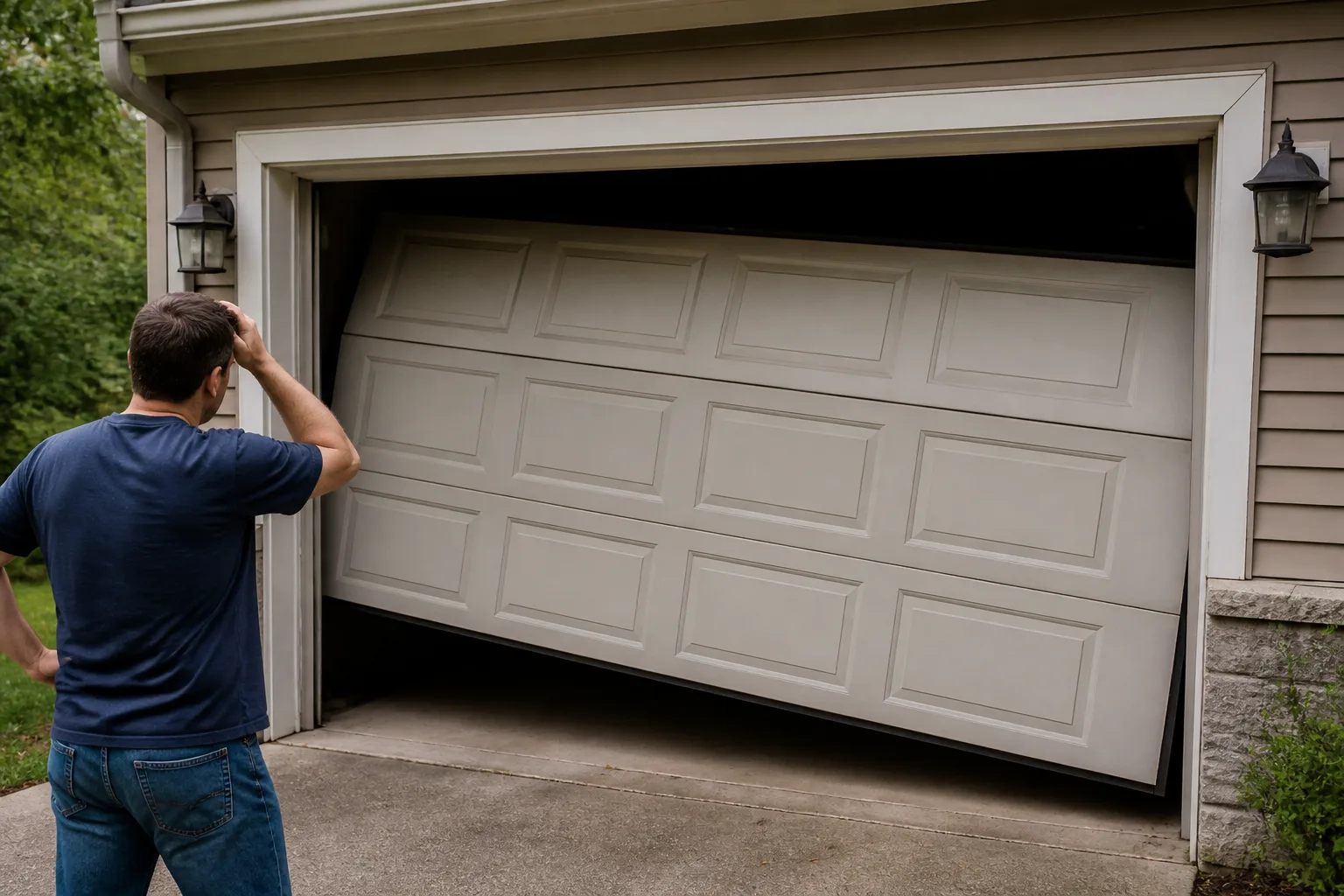
Cables are the next thing to look at, not touch. A cable that’s off its drum, frayed, or lying slack along the side of the track points to a cable failure, and a door with a failed cable can drop without warning. Track damage shows up as a bent or separated section, usually near the bottom where a car bumper or a forced lift has pushed it out of alignment. If the door is crooked in the frame, the springs and cables aren’t lifting it evenly, and that’s a dead stop too.
- Spring: visible gap, split coil, or loose hanging hardware on the shaft or side tracks.
- Cable: slack or frayed cable, cable off the drum, door sitting crooked.
- Track: bent or separated rail, roller popped out of the channel.
- Opener only: door moves freely by hand (carefully) but the motor does nothing, or the motor runs and the door doesn’t.
Anything in the spring or cable category is high-tension hardware under load. Don’t put your hands near it, don’t try to wind or unwind anything, and don’t take the door down. This is the point where trained technicians with the right winding bars and the right replacement spring do the work. We handle spring work as a dedicated service for exactly this reason.
How to Use the Emergency Release Cord Without Damaging the Door
The red release cord disconnects the door from the opener, not from gravity. Pull it while the door is up and the door comes down fast, and a falling door bends panels and tracks and can injure whoever is underneath. The safe sequence starts with the door fully closed.
- Make sure the door is all the way down. If it’s partway up, leave it and call. Don’t try to walk it down.
- Stand to the side of the door, not under it. Keep both feet clear of the door’s path.
- Grip the bottom section at the center with one hand to steady it, and pull the release cord straight down with the other. The trolley should pop free of the carriage.
- Don’t let go. Once released, the door is unsupported by the opener. Lower it slowly if it isn’t already down, or hold it while a second person checks that nothing is in the way.
- Once it’s down and disconnected, leave it down. The door is no longer secured by the opener, so treat the bottom section as the only lock you have.
If the door won’t budge after release, something mechanical is binding: a cable off its drum, a bent track, or a roller out of the channel. Stop there. Forcing it is how a track replacement gets added to the job. Any failure that starts inside the door’s own structure is worth a professional look; our garage door repair team deals with binding doors, bent tracks, and dead trolleys every week, and we’d rather diagnose the actual cause than swap parts until it moves.
Securing a Stuck-Open Door in Tremont While You Wait
A door stuck open in Tremont is a security problem first and a weather problem second. The goal in the meantime is to make the opening visibly occupied and physically harder to walk through: that’s it. You’re not fortifying anything; you’re buying hours.
- Park a car in the opening if you can do it without hitting the door or the track. It’s the single most effective temporary measure.
- Put something visibly inconvenient in the doorway (a stack of bins, a patio chair) and keep a light on. Most opportunists are looking for the easy opening, not a puzzle.
- Lock the service door between the garage and the house if there is one, and move anything valuable out of sight from the street side.
- Don’t block the door’s travel path. Anything you wedge under the bottom section can jam the track, and a door leaning on a stacked object can drop it when it moves.
- Don’t tape or screw panels shut. Whatever you do to seal the opening by force is work the technician has to undo before the repair starts, and it can bend panels that weren’t bent.
Avoid the temptation to prop the door with a broom handle or a two-by-four across the track. It looks like security and behaves like a leverage point. Whatever’s holding a dead door open only needs to slip once, and the noise it makes is not the one you want at night. If the door needs a full replacement rather than a repair, our garage door installation page covers how that process is measured, ordered, and scheduled.
How to Describe the Failure When You Call for Emergency Service
The four things that determine how fast a technician arrives with the right parts are: what failed, what the door is doing right now, what brand the system is, and whether the door is open or closed to the weather. Get those in the first two sentences and you skip the back-and-forth.
- What failed: “The spring above the door snapped” or “the cable came off the drum” or “the door is crooked and the opener won’t move it.” Point to the part, don’t describe the noise.
- What the door is doing: stuck open, stuck closed, or half up and hanging. Say the position plainly. A door hanging halfway is a different call than one sitting closed.
- Brand: look at the label on the door and the opener housing. If it’s a LiftMaster, Chamberlain, or Craftsman opener, say so; if it’s a Wayne Dalton or Raynor door, say that. We’re familiar with all eight major brands, and knowing whether you’ve got a LiftMaster or a Wayne Dalton system when we take the call is the difference between a truck that carries the right part and one that has to come back in the morning.
- Open to the weather: a stuck-open door at night or in the rain gets prioritized over a closed door that’s simply not usable, because it’s a security and water problem both.
Add anything that’s unsafe about the situation (kids, pets, a car inside, a sagging section you think might fall) and we can plan around it. We’d rather ask three extra questions on the phone than have you standing in the driveway guessing.
What Same-Night Emergency Service in Tremont Realistically Covers
Same-night, what’s achievable is almost always the safety part. A technician can get the door back into a secured, level position, disconnect a dangerous operator, brace or release a sagging section, and make the opening weather-tight if it’s sitting open. That’s the call that matters at 10 p.m., and that part is very often doable.
What tends to wait for a morning parts run is anything requiring a brand-specific component that isn’t on hand: a matched spring pair in the right size, a door panel, a specific opener carriage from a Wayne Dalton or Craftsman system, a replacement roller set for a track that’s been run bent. Sizing a torsion spring correctly means matching wire gauge, inside diameter, and length to the door’s actual weight, and that’s not something you want estimated from memory at night.
What you should always get before anything starts: a diagnosis of the actual cause, a quoted price for the work, and the price agreed before the technician touches the door. No work starts on a number you haven’t heard and agreed to.
When to call a pro instead of working it out on your own
Call us when the door is crooked in the frame, when a spring or cable is visibly broken, when the door moved on its own after you released it, or when the opener is making a straining noise and the door isn’t moving. Any of those means high-tension hardware is involved, and it’s not a job for hands, a pry bar, or a YouTube video. Our technicians have up to 12 years of experience, and the spring work in particular is exactly the kind of repair a general handyman will tell you to take elsewhere.
If you’re in Tremont and need help tonight, call (855) 337-1175. If it’s an opener issue and the door itself is fine, our garage door opener repair team can look at both. And for the full picture of what we handle, our Garage Door Repair Tremont page covers the whole service range.
The Bottom Line
Don’t force a dead door. Identify whether it’s a spring, cable, or track failure before you touch anything, release the opener only with the door fully closed and never let it free-fall, secure a stuck-open door with a car and a light rather than force, and call with the four facts that let a technician bring the right parts the first time. Most of the expensive damage we see isn’t from the failure itself. It’s from the 15 minutes after.
If you’re in Tremont and need help, Garage Door Repair Tremont offers free estimates. Call (855) 337-1175 and we’ll find the actual cause, not just the symptom.
Frequently Asked Questions
Look before you lift. Check the spring above the door and the cables along each side for a visible break, then try the door by hand with the opener disconnected only if nothing looks broken. If anything is visibly snapped, slack, or bent, leave the door alone and call. Forcing a door with a failed spring or cable is how a single repair turns into a track and panel job.
No. A torsion-spring door with a failed spring has no counterbalance, so you’re lifting the full weight of the door by hand, and a door that gets away from you comes down hard. The same applies to a door with a failed cable. That’s the specific reason the emergency release exists only to disconnect the opener when the door is fully down. Call a technician instead of lifting it yourself.
Not after the quote is given and agreed. We diagnose the actual cause, quote the repair, and get your agreement before any work starts. The written quote is the price for the work. If we find something during the repair that wasn’t visible at diagnosis (a second issue behind the first), the work stops until you’ve agreed to the change.
Yes. The local professionals we connect you with are licensed and insured as the state requires. If you’d like details before booking, call (855) 337-1175 and we can talk through it. Estimates are free.
Written by the team at Garage Door Repair Tremont.
Need Garage Door Help?
Call Garage Door Repair Tremont - the local pro we connect you with is licensed and insured, here with fast after-hours help in Tremont.
(855) 337-1175